

📍
Oklahoma Legends of Lost Treasure
Dalton Gang Loot at Onion Creek
The Dalton Gang of outlaws buried gold and silver coins from two bank robberies at their campsite not far from an old wooden bridge where Onion Creek meets the Verdigris River. They were heading out to rob a Coffeyville bank and planned to return for it later, but their final robbery was a disaster and only one of the outlaws survived who was sent to prison. Explore More
Mexican Gold at the Antelope Hills
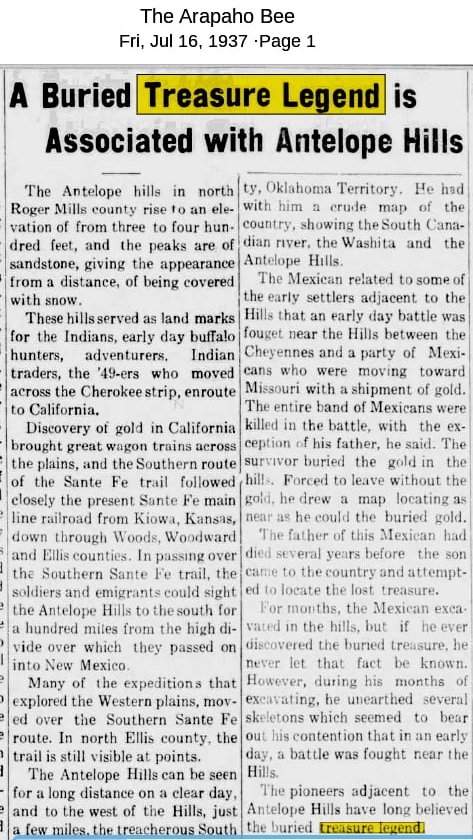
In the early to mid 1800s, near a bend in the South Canadian River where it used to wrap around the distinctive towering landmarks of the Antelope Hills in Oklahoma, a well-equipped party of Mexican prospectors were traveling from the Southwest after successfully mining a massive haul of gold bullion. As they headed east across the plains following the natural path carved by the river, their caravan was surrounded and ambushed by a large Comanche or Kiowa war party. As the warriors closed in, the miners scrambled quickly to relieve themselves of the heavy gold load that might slow them down, while trying to hide it to keep it from falling into enemy hands. They dropped down into one of the rugged sandy ravines toward the south bank of the river and buried their treasure. Since they were greatly outnumbered, they attempted to flee, but a battle ensued, and only a few of the Mexicans escaped who were never able to safely return. Since then, the area where the river bend was has drastically changed. In the 1800’s, it was an unpredictable wide torrent with shifting sand beds. The Canadian Valley was known for “quicksand” and flash flooding with frequent shifting and erosion. Then in 1939 when the Conchas Dam and Ute Reservation were built in New Mexico, as well as the Sanford Dam in Texas, the river shrunk by 90%, flattening the old bend and transforming the area into a wide flat valley with a much narrower straighter channel that meanders through thick sand bars, mudflats, and encroaching brush. If the gold were buried high enough up above flash flooding areas it might have survived, but if lower could have been displaced and washed down stream during one of the many flash floods, dragged along the bottom of the river until it sunk under the sands in any deep pocket areas. The region is now entirely privately owned ranch lands, so any attempts to search for the treasure will require permission.
Outlaw Treasure at Lost City
In 1917, outlaw Cole Younger of the Jesse James gang on his deathbed told a cousin that 40 years prior the gang stopped during a blizzard to hide $63,000 either by burying it in the ground or placing it within a crevice at the face of Lost City mountain near the sandstone bluffs 6 miles west of Tulsa, Oklahoma. Lost City is now a ghost town. The cousin set out with gear to search, but was said not to be able to locate the loot. Explore More

The Tres Piedras Legend
Along the old Santa Fe Trail mysterious V-shaped stones were believed to mark the route to a huge cache of gold bars buried near the Black Mesa and Flag Spring area by Frenchmen. Later three corner point stones were found, but the treasure location could never be pinpointed until possibly more recently. A descendant who bought the land, surveyed the area, and claims to have found the fourth stone, realized the stones were placed based on magnetic north instead of true north, so now claims they have been able to pinpoint more closely the believed actual location which they discovered was near a cave where the Frenchmen appeared to have taken refuge for the winter, near the ruins of an ancient dugout, although he still has not been able to unearth it. Explore More
Train Robbery Loot in the Hills Near Okemah
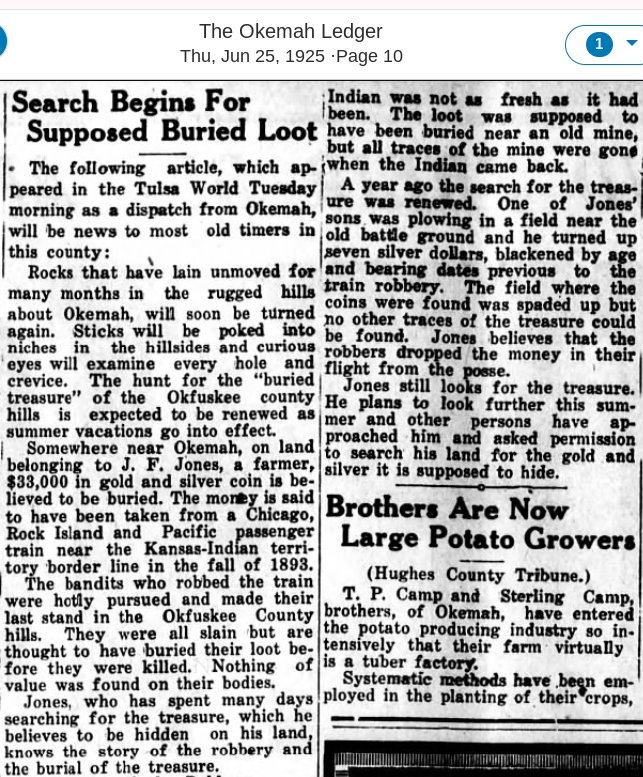
In 1893, a band of four outlaws robbed a Chicago Rock Island and Pacific passenger train about midnight. Two of the men blew open the safe in the express car and obtained currency and silver worth more than $33,000, while the other two robbed passengers of their money and valuables. Following the heist, a posse was formed that pursued the bandits relentlessly into the rugged and heavily wooded Okfuskee County Hills where a deadly shootout ensued. Every single member of the outlaw gang was killed, and no valuables were found on them, so it was assumed they buried the stolen loot somewhere in the hills near Okemah. There was a witness – an Indian boy who left out of fear and didn’t return until many years later in 1924. He shared his story with a local farmer, J.F. Jones, who owned the land he believed the treasure might be on. The Indian saw the robbers bury the loot near an old mine, but he could not find it again after all those years when he searched for it with Jones. One of Jones’s sons did unearth seven silver dollars bearing a date previous to the train robbery while plowing, but no more coins were found there, and he believed they were dropped as the outlaws were fleeing from the posse. The rest of the missing money and valuables have never been recovered.
Search
Follow Us